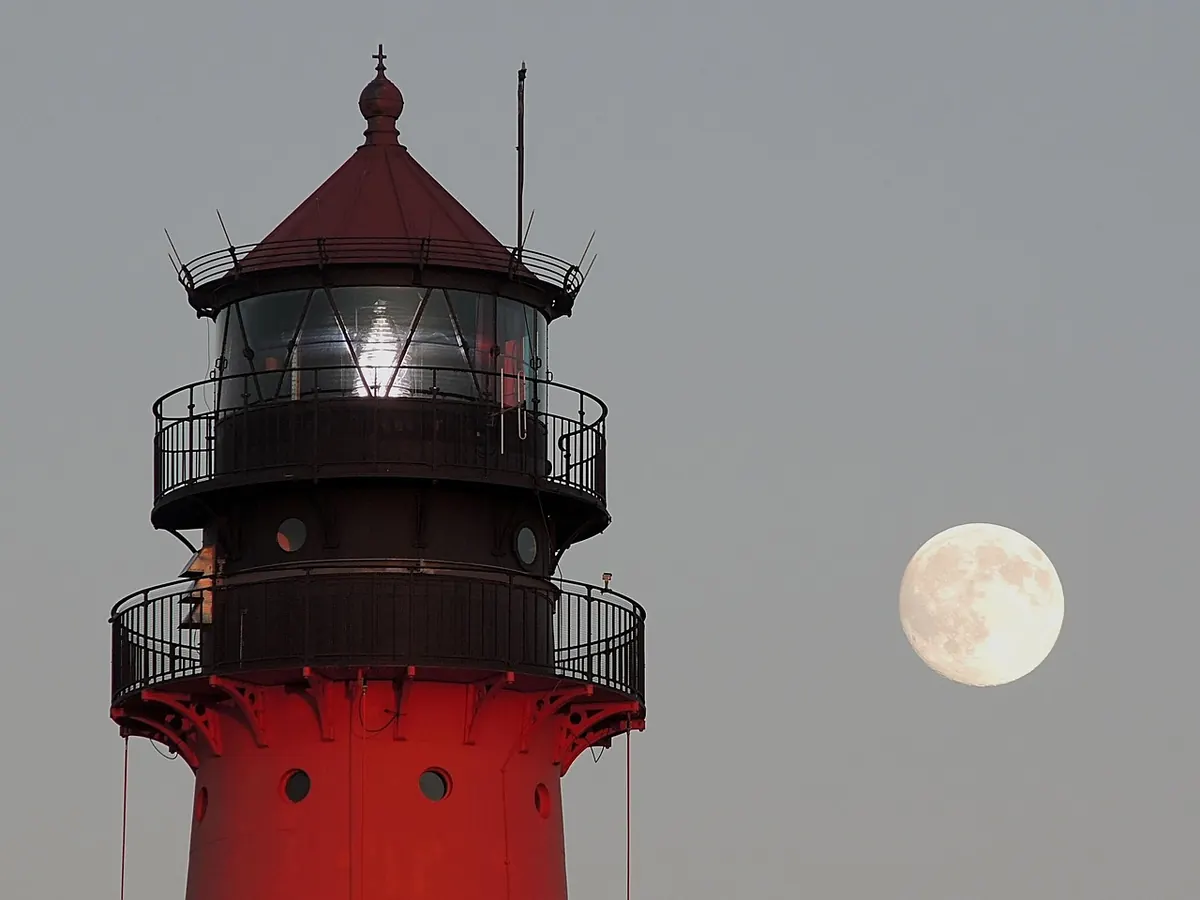
Two hundred steps up, and the vocabulary changes. What you called "the big glass lamp" is a lantern room. The railing you are gripping belongs to the gallery, and the low wall in front of it is the parapet. The glass drum around the light — the thing that made you stop talking for a second — holds a Fresnel lens, or what many keepers simply called the optic.
None of these words are decoration. They are the working language of the people who built, kept and charted these towers, and they are still the words used in maritime guides, on nautical charts and on the plaques by the gate. Learn a dozen of them and a lighthouse stops being a monument and becomes a machine you can actually read.
The Tower Before You Reach the Top
Start at the bottom. Most towers sit on a broad base, sometimes called a plinth, and rise in a shaft that narrows as it climbs. That deliberate taper is called batter, and it is one reason a well-built tower shrugs off wind that would push a straight cylinder around.
Look at the material while you are down there. Masonry, brick, cast iron, concrete and, on some offshore stations, skeletal steel frames all appear in lighthouse construction, and each one shows its age differently. Cast-iron plates are bolted in courses and often carry a maker's name; masonry shows the tooling marks of the masons who cut it.
Around the tower you will usually find the supporting buildings: the keeper's quarters, the oil house where fuel was stored away from the light, and the fog signal building. Many stations also had a small workshop and a store. These outbuildings matter more than they look — a light was only as reliable as its supply of oil, wicks and clean glass.
Inside, just below the top, sits the watch room. This is where the keeper kept the log, the spare parts and, in many towers, the descending tubes that carried the clockwork weights. It is the room that makes sense of everything above it.
The Lantern Room, Explained Properly
The lantern room — usually just "the lantern" — is the glassed-in space at the summit that protects the light from weather while letting the beam out. Its panes are set in a metal framework, and the thin bars between the glass are called astragals or muntins. Count them on a stormy day and you will understand why keepers spent so much time polishing: every bar and every pane collects salt.
At the very top of the roof sits the ventilator ball, a rounded vent that lets fumes and stale air escape without letting rain in. It is usually topped with a lightning conductor. Inside, the lens rests on a pedestal, and the whole assembly sits on a floor built to carry real weight — cast iron, steel or bronze in most towers.
Some towers have a service room between the watch room and the lantern, used for preparing the lamp and storing small supplies. If a guide mentions "the service room" and you have already passed the watch room, that is what you missed.
Gallery, Parapet, Balcony: The Walkway Vocabulary
The gallery is the outdoor walkway that rings the lantern room, and it is the part most visitors remember. It exists for maintenance: cleaning glass, checking ventilation, trimming the lamp in the days before electricity. Some books call it a balcony, and on older plans you will see it as a gallery deck.
The parapet is the low solid wall at the outer edge of that walkway. Where there is no parapet, there is a railing. Supporting the whole thing from below are brackets or corbels, which are the decorative-looking arms you see jutting from the tower on the way up. On skeletal towers, a narrow catwalk often serves the same purpose as a gallery.
A quick way to keep the three main terms apart:
- Lantern room — the glazed room where the lens and lamp sit.
- Gallery — the walkway outside it, where you stand to look down.
- Parapet — the wall or guard at the gallery's edge that stops you going over it.
The Fresnel Lens and the Words That Come With It
Before the 1820s, lighthouse optics were reflectors: mirrors behind a flame, throwing a useful but greedy beam. Augustin-Jean Fresnel, a French engineer, changed that by building a lens out of concentric rings of glass prisms, each ring bending light into a horizontal beam instead of letting it scatter upward and downward.
A Fresnel lens is not one piece of glass. It is an assembly: a central bullseye that refracts light directly, prism rings that bend it by refraction (dioptric), and outer prisms that reflect and refract at once (catadioptric). The result is a lens that looks like a beehive made of glass and can throw a beam many times brighter than the flame inside it.
Lenses were graded by order, from first to sixth. First-order lenses were the giants of major landfall lights, standing close to three metres tall; sixth-order lenses were small enough for a harbour light and could almost be carried by one person. Big lenses rotated on a bath of mercury to cut friction, driven by clockwork and a descending weight that had to be wound back up — a job that shaped the keeper's whole night.
Keepers often said "optic" rather than "lens", and the word survives in museum labels and restoration reports. If you see both, they mean the same glass.
Light Characteristics: Reading the Chart Like a Keeper
A lighthouse is identified by its light characteristic — the rhythm of flashes and dark periods — because at night that pattern is all a navigator has. Learn a handful of abbreviations and the notes in any maritime guide open up:
- F — fixed: a steady light, no flashes.
- Fl — flashing: dark longer than it is lit.
- Oc — occulting: lit longer than it is dark.
- Iso — isophase: equal periods of light and dark.
- Fl(2) — group flashing twice, then a pause, then twice again.
- Q and VQ — quick and very quick flashing.
Alongside the pattern you will see a period in seconds, the height of the focal plane in metres (the height of the light itself above high water, not the height of the tower), and a nominal range in nautical miles. Coloured sectors — red or green arcs within the white — mark safe water and hazards, and a pair of lights lined up to guide a vessel into a channel is called a leading light or range light.
Decoding a Guidebook Entry
Take a typical line: Fl(2) W 10s 34m 18M. Read it left to right and it says: the light flashes in groups of two, the light is white, the full pattern takes ten seconds, the focal plane is thirty-four metres above high water, and the light is nominally visible for eighteen nautical miles in clear air.
Two of those numbers are routinely confused. Tower height is what you climb; focal plane is where the lamp sits. A tower listed at twenty metres can carry a focal plane of fifty if it stands on a headland. When a guide quotes a range, remember it is a nominal figure calculated for a standard observer — sea haze, rain and background shore lights all cut it down in practice.
Using the Vocabulary on Your Next Visit
Arrive with five questions and you will leave knowing more than most people on the tour. What order is the optic? Is the lens original or a replacement? Where was the clockwork, and is the weight tube still there? What is the focal plane height? And what is the light's characteristic?
Then look for the small evidence that guides often skip. Find the maker's plate on the lantern frame or the lens pedestal. Note whether the gallery is supported by corbels or a cast ring. Check whether the parapet is solid or pierced, and whether the railing is original iron or modern steel. Photograph the chart extract or the notice board, because those abbreviations are easier to decode later with the list above beside you.
Finally, stand on the gallery and count the flashes yourself. If the pattern in the guide matches what you see, you have just read a lighthouse the way a navigator does — which is the whole point of learning the words.